
Demonstration Notice: Reference editorial article demonstrating ARC & EPOCH’s Signal format.
The Signal
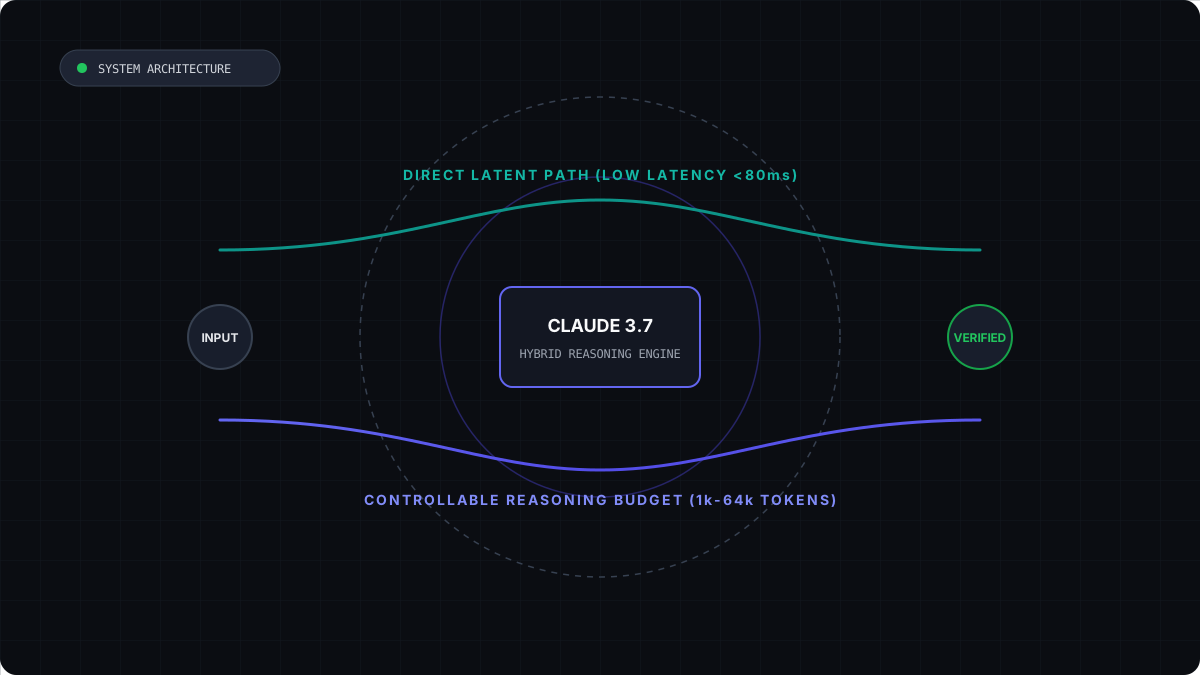
Anthropic unveiled Claude 3.7 Sonnet, introducing an architectural shift: hybrid dynamic reasoning. Rather than forcing developers to bifurcate their pipelines between separate “reasoning” and “standard” models, the model accepts an explicit thinking parameter controlling internal test-time compute allocation.
Technical Consequence
In standard production API integrations, reasoning models frequently incur excessive latency on straightforward tasks while standard models fail on complex multi-step symbolic logic.
By parameterizing test-time search through a controllable thinking budget (from zero tokens up to 64k tokens per request), developers gain direct algorithmic control over the cost-latency tradeoff curve:
- Zero Thinking Budget: Acts as an ultra-low latency instruction-tuned model for conversational routing and simple code completion.
- Extended Thinking Budget: Allocates search tokens across difficult competitive coding, formal mathematics, and architectural reviews.
What to Monitor
Systems teams should evaluate their request gateway timeouts. Requests with maxed thinking budgets can sustain 45-to-90 second generation windows, requiring streaming WebSocket or asynchronous webhook delivery architectures rather than synchronous HTTP roundtrips.